
How Do I Choose a Trending Haircut That Works for My Hair?
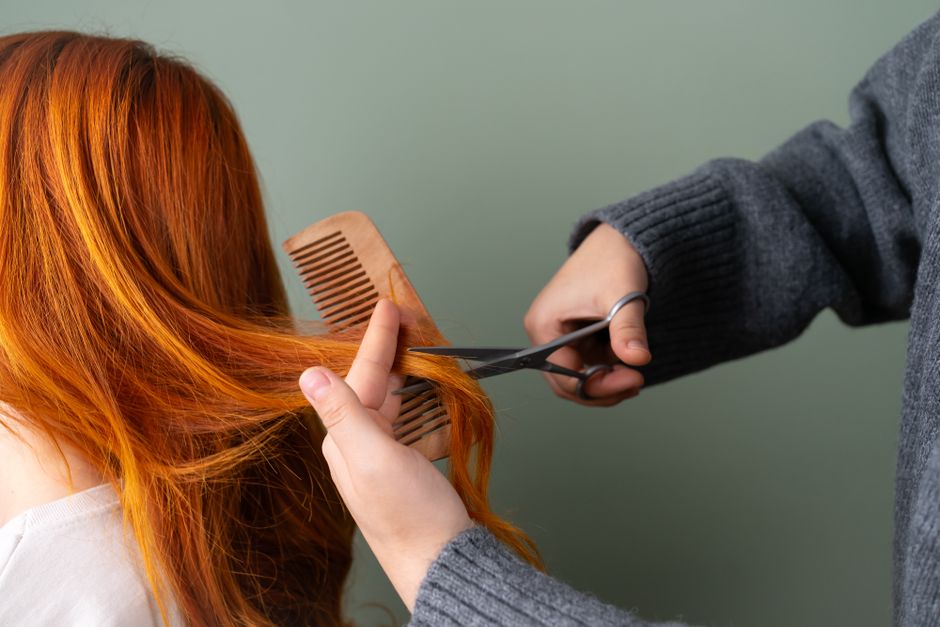
Choose the trend only after you name four facts: your natural texture, density, usual styling routine, and the upkeep you accept. Bring a small set of photos, then ask your stylist to translate the shape, length, and fringe for your own hair. A good consultation turns an inspiration image into a plan, not a promise.
A haircut photo shows one result under one set of conditions. It does not show the model's density, curl pattern, extensions, heat work, or daily routine. The useful question is not, “Can I have this exact cut?” It is, “Which parts of this cut will work on my hair?”
How do I ask my stylist for a trending haircut without getting the wrong result?
Ask for the parts of the trend you want, then state the limits that matter: length, natural texture, styling time, and deal-breakers. Name the shape before the label. A “bixie” or “lob” is a shorthand; the outline, layers, and fringe determine the lived-in result.
Consultation is not filler. The California Board of Barbering and Cosmetology assigns 19% of its cosmetologist theory examination, effective April 1, 2026, to client consultation and hair, skin, and nail analysis. Its haircutting outline also covers different hair types, including straight, curly, over-curly, and wavy hair.
That focus has a plain purpose. The cut should follow the hair in the chair, not the name on the photo.
The Connecticut Department of Public Health requires hair analysis training that includes texture, elasticity, porosity, density, and length. Its curriculum also requires dedicated classroom and clinical hours serving textured hair, including curl and wave patterns, strand thickness, and hair volume. Those are the facts worth putting on the table before scissors move.
Use a short script. Change the words, not the order:
- “I like this shape and this length.”
- “My hair is [straight, wavy, curly, or coily] and feels [fine, medium, or coarse].”
- “I usually [air-dry, diffuse, blow-dry, or heat-style] it.”
- “I can spend [your chosen amount of time] styling it.”
- “I do not want [short fringe, exposed neck, thin-looking ends, daily heat styling, or frequent trims].”
- “Show me what you would change so this works on my hair.”
For a bob, ask where the line will land when your hair is dry. For layers, ask which layer is shortest and what remains at the perimeter. For bangs, ask how they sit without heat styling. For a pixie or bixie, ask how often the outline needs reshaping.
| Trend direction | Useful consultation question | Source-based trade-off |
|---|---|---|
| Bixie | Will this shape suit my texture and my styling routine? | The Kit says a current bixie suits medium-to-thick straight or wavy hair; very thick, coarse hair can need daily styling and frequent trims to hold its shape. |
| Collarbone lob | Can the perimeter stay blunt with only soft face framing? | The Kit describes this form as mostly blunt with subtle face-framing layers, and says it can make fine-to-medium-density hair appear thicker. |
| Long blended layers | Can I still air-dry it and wear a ponytail or bun? | The Kit describes longer, blended “invisible layers” as compatible with air-drying on curlier textures and with ponytails and buns. |
Current does not mean high-maintenance. Softer, customized shapes are the 2026 direction identified by stylist Morgan Tully in The Kit. The trend is less useful than the fit.
How many reference photos should I bring to a haircut appointment?
Bring three useful photos: one for the front, one for the side or back, and one for the detail you want copied or avoided. More images can blur the request when they show different lengths, textures, and styling methods.
Pick photos with a job. The front photo can show fringe, parting, and face framing. The side or back photo can show the outline, nape, and graduation. The third photo can show movement, density, or the amount of layering you want.
Bring one “no” photo if a specific outcome worries you. It can show bangs that feel too heavy, layers that look too sparse, or a bob that sits too round. A clear boundary saves more time than a folder full of near-matches.
Read the photo before you present it. Look for extensions, filtered texture, ring-light shine, and hair that has been curled or straightened. Those details do not make the image useless. They tell you which feature is styling and which feature is the cut.
One photo can ask for length. Another can ask for shape. Do not ask a single photo to settle every question.
Texture changes the meaning of length. In Allure, salon owner Michaella Blisset-Williams says that taking one inch from natural hair when it is straightened can look like two and a half inches once it returns to a curly state. A photo should start the conversation about the finished dry length, not end it.
Will a haircut photo work if the model has different hair texture than mine?
A haircut photo can work across textures when you use it for shape and proportion, not as a guarantee of the same finish. Texture, density, shrinkage, and styling method change where layers sit, how a fringe falls, and how much length appears to disappear.
Curly and coily hair need a more exact conversation. Allure reports that curly cuts are commonly done on natural, typically dry texture so the stylist can see the curl pattern and build an individual shape. The consultation described in that report covers hair history, products, routine, curl pattern, density, texture, and curl quality before cutting technique is chosen.
Arrive in a state that shows the hair honestly when your appointment is for textured hair. FASHION Magazine reports stylist guidance to wash curly hair the day of or the day before, let it dry naturally, and avoid pulling it into a bun, ponytail, braid, hat, clips, scarves, or heavy oils. The stylist sees more when the hair is not forced into another shape.
Ask these questions before a major length or fringe change:
- “What will this look like on my natural texture after it dries?”
- “Where will the shortest piece land?”
- “Will this still work on the days I do not use heat?”
- “What part of the photo depends on styling rather than cutting?”
- “How will it grow out, and when will the shape need a trim?”
Length is easy to remove. Shape takes longer to read. The better photo is the one that gives the stylist room to tell the truth.
Frequently Asked Questions
What should I tell my stylist if I air-dry my hair most days?
Say that air-drying is your normal routine before the cut begins, then describe the texture and shape your hair takes once dry. Ask the stylist to plan the cut around that result rather than a heat-styled finish. The Kit notes that current softer shapes are being tailored to texture and lifestyle, and its long, blended layers are described as compatible with air-drying on curlier hair.
How do I explain that I want layers but do not want my hair to look thin?
Ask for the purpose of each layer and state that keeping visual fullness is the priority. Bring a photo that shows the amount of movement you want, then ask where the shortest layer will sit and how the perimeter will remain. The Kit describes a collarbone-length lob with a mostly blunt line and subtle face-framing layers as a shape that can make fine-to-medium-density hair appear thicker.
What questions should I ask about grow-out and haircut maintenance?
Ask how the shape changes between trims, what at-home styling it needs, and when the stylist expects the next appointment. For textured hair, Fashion Magazine reports a recommendation for regular trims every three to four months to address thin or wispy ends and limit splitting. Allure reports that curly-cut clients are commonly given an estimated follow-up date of three to four months or longer.